
Yellow Card review: licences in Africa and the widget for individuals
By Wealth.cat editorial team Updated October 18, 2026 Facts verified on October 18, 2026
Yellow Card now sells stablecoin infrastructure to businesses; its South African company is FSCA-authorised (FSP 53790) and its Botswana company holds an NBFIRA licence.
Key facts
- Regulators
- FSCA, NBFIRA
- Proof of reserves
- not published
- Deposits and withdrawals
- Bank transfer
- Founded
- 2016
Facts checked on October 18, 2026. Details and sources below.
Pros
- South African company authorised for crypto assets by the FSCA (FSP 53790)
- Botswana company holds a virtual asset service provider licence from NBFIRA
- Publishes the company and the licence or registration for each country
- Widget sales can be paid out to a bank account or mobile money
Cons
- The site is built for businesses; there is no public fee table
- The Nigeria, Ghana and Zambia companies hold registrations or approvals, not licences
- No published withdrawal fees for USDT or USDC
- Its help centre blocks crawlers, so we could not read it
Licences and legal entities
| Legal entity | Regulator | Licence no. | What we checked |
|---|---|---|---|
| Yellow Card Financial South Africa (Pty) Limited | FSCA (South Africa) | 53790 | October 18, 2026 |
| Yellow Card Botswana Proprietary Limited | NBFIRA (Botswana) | 11/1/5(1) | October 18, 2026 |
| Yellow Card Financial Nigeria Limited | SEC Nigeria (Nigeria) | — Registration or provisional approval, not a licence | October 18, 2026 |
| Yellow Card Ghana Limited Company | BoG (Ghana) | — Registration or provisional approval, not a licence | October 18, 2026 |
| Yellow Card Services Zambia Limited | BoZ (Zambia) | — Registration or provisional approval, not a licence | October 18, 2026 |
| Yellow Card Rwanda Limited | FIC (Rwanda) | — Registration or provisional approval, not a licence | October 18, 2026 |
| Yellow Card Tanzania Limited | FIU (Tanzania) | — Registration or provisional approval, not a licence | October 18, 2026 |
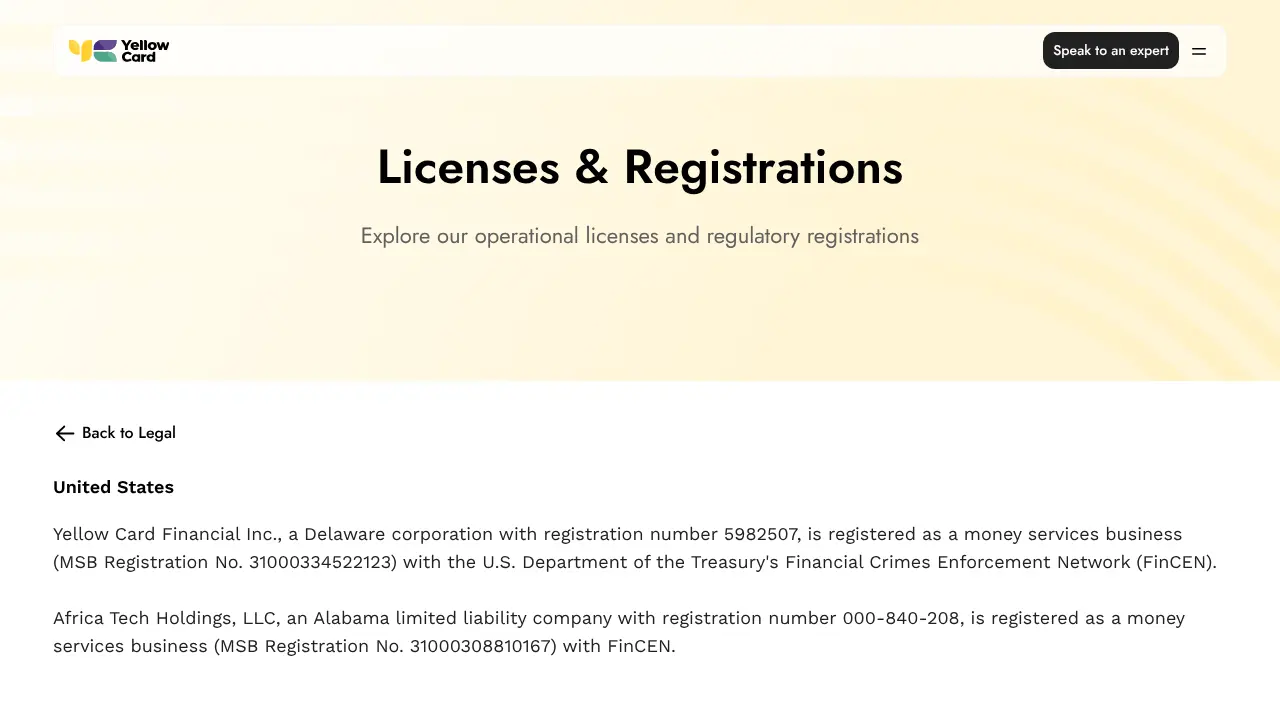
| Yellow Card Financial Inc. | FinCEN (United States) | 31000334522123 Registration or provisional approval, not a licence | October 18, 2026 |
| Africa Tech Holdings, LLC | FinCEN (United States) | 31000308810167 Registration or provisional approval, not a licence | October 18, 2026 |
| Alkepay Inc. | FINTRAC (Canada) | C10001750 Registration or provisional approval, not a licence | October 18, 2026 |
| StaaS Fintech Services SA | SO-FIT (Switzerland) | 1571 Registration or provisional approval, not a licence | October 18, 2026 |
| Afritech Services Sp. z o.o. | IAS Katowice (Poland) | RDWW-1069 Registration or provisional approval, not a licence | October 18, 2026 |
Futures and earn products
- Proof of reserves
- not published
Deposits and withdrawals
| Method | Deposit | Withdrawal | Fee | Time |
|---|---|---|---|---|
| Bank transfer | No | Yes | Rate and fees shown before each transaction | — |
Ratings on other platforms
What users of app stores and TradingView give Yellow Card. These are their ratings, not a Wealth.cat score.
| Platform | What is rated | Rating | Ratings | Checked |
|---|---|---|---|---|
| Google Play | YellowCard: Buy & Sell Bitcoin | 3.3/5 | 21.9K | October 28, 2026 |
| App Store | YellowCard: Buy & Sell Bitcoin | 3.3/5 | 740 | October 28, 2026 |
App store ratings rate the company’s mobile app. Counts with K or M are rounded by the platform.
This summarises what reviewers wrote; we did not verify their claims, and companies can invite customers to leave reviews.
Screenshots
Pages we captured in a browser on the date shown. Pages can look different in your country.
What Yellow Card is today
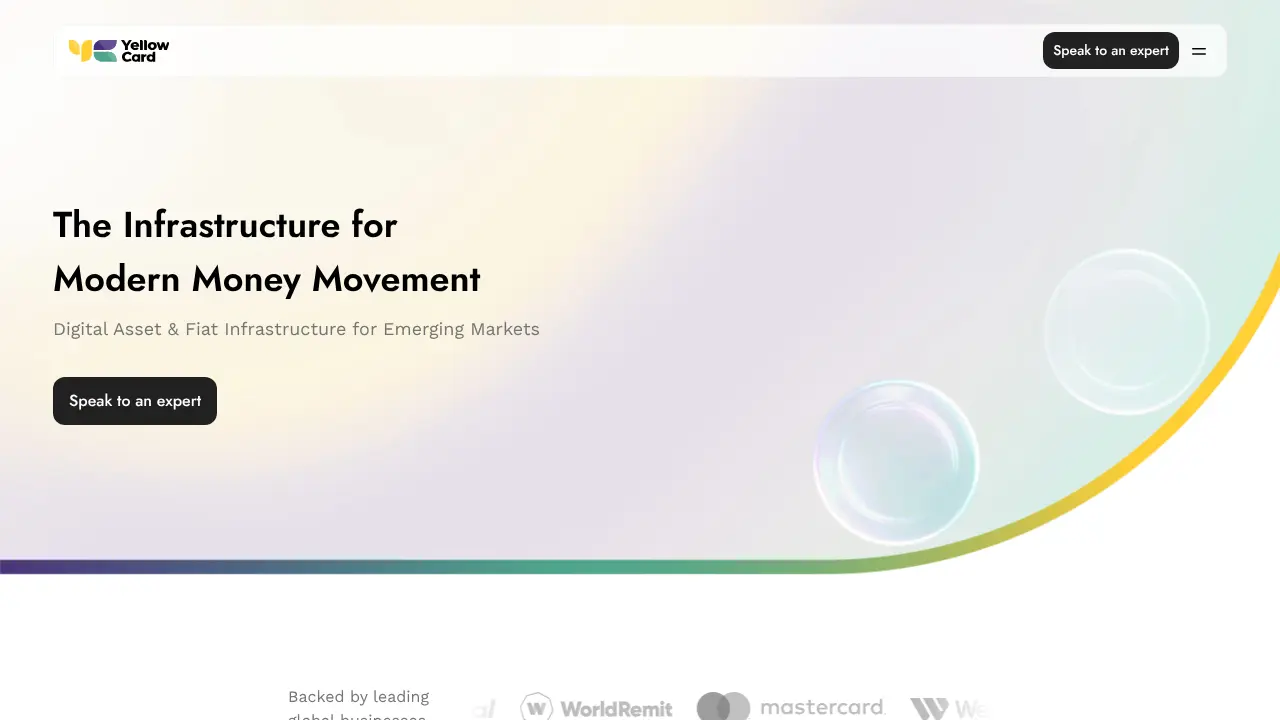
Yellow Card was founded in 2016. Its parent company, Yellow Card Financial Inc., is incorporated in Delaware, with a principal business office in Birmingham, Alabama, and owns the local companies listed below. The website now presents Yellow Card as stablecoin payments infrastructure, “enabling banks, financial institutions, corporates, and other businesses” to store, send and manage stablecoins and local currencies. There is no retail sign-up or retail fee page on the site. All facts in this review were checked on 18 October 2026 on Yellow Card’s own pages.
Licences and registrations
Yellow Card lists its companies country by country, each with its authority:
- South Africa: Yellow Card Financial South Africa (Pty) Limited is a Category I financial services provider “with authorisation in respect of crypto assets”, regulated by the Financial Sector Conduct Authority (FSP 53790). It is also a third-party payments provider under bank sponsorship and registered with the Financial Intelligence Centre.
- Botswana: Yellow Card Botswana holds a virtual asset service provider licence (Certificate No. 11/1/5(1)) issued in 2022 by the Non-Bank Financial Institutions Regulatory Authority.
- Nigeria: Yellow Card Financial Nigeria Limited was admitted in August 2026, on a conditional approval-in-principle basis, to the SEC’s Accelerated Regulatory Incubation Program.
- Ghana: registered as a virtual asset service provider with the Bank of Ghana since August 2025, and a participant in the SEC Ghana sandbox since April 2026.
- Zambia: registered as a virtual asset service provider with the Bank of Zambia (Circular 05/2026).
- Rwanda, Tanzania, Malawi, Uganda: registered for financial-crime reporting with the local Financial Intelligence Centre, Unit or Authority; in Tanzania an application to the Bank of Tanzania’s fintech sandbox is pending.
- Outside Africa: two US companies are registered as money services businesses with FinCEN, a Canadian company with FINTRAC (fiat only), a Swiss company is a member of the self-regulatory organisation SO-FIT (corporate clients only), and a Polish company is on Poland’s register of virtual currency businesses (no EU customers).
Only the South African and Botswana entries are licences; we mark the others as registrations. We did not check these numbers in the regulators’ registers.
Using Yellow Card as an individual
Individuals use Yellow Card through the Yellow Card Widget, which works “from any supported website, exchange or DApp”. You sign up with an e-mail address; the account is a profile, not a wallet, so you cannot keep money or crypto in it. When you buy, Yellow Card sends the crypto to a wallet address you provide; when you sell, it pays you in local currency to your mobile money or bank account. The accounts and wallet must be in your own name. Payment methods for buying are shown only during the purchase.
Fees, networks and currencies
Yellow Card shows the rate and fees before each transaction but publishes no fee table, so this review has no trading or withdrawal fees. Its business page lists the networks it handles: USDT on TRC20, Celo, TON, SOL and Polygon, and USDC on ERC20, Celo, Base, XLM, SOL and Polygon. The site lists more than 50 payment currencies in over 60 countries for its business network — among them NGN, GHS, KES, ZAR, XOF, XAF, UGX, TZS and ZMW — but does not say which of them the widget supports for individuals.
Earn products
The business page offers to “Earn Yield on your Stablecoin Balances”, while the legal page says Yellow Card does not undertake staking or lending. Because the two pages disagree, we do not list an earn product. Yield is never guaranteed, and you can lose part of the balance.
Before you use it
- Check which Yellow Card company is behind the app or website you use, and whether it holds a licence or only a registration.
- Compare the quoted rate and fees with another provider before you confirm.
- Make sure the network of your wallet matches the one Yellow Card sends on.
We have not tested Yellow Card with our own account yet; this review will be updated when we do.
Frequently asked questions
Is Yellow Card regulated?
Yes. Yellow Card operates through entities licensed by FSCA (South Africa) and NBFIRA (Botswana). Licence numbers and legal entities are listed in the licences table on this page.
How is Yellow Card rated on other platforms?
As of October 28, 2026: Google Play 3.3/5 (21.9K ratings) and App Store 3.3/5 (740 ratings). Weighted by the number of ratings, the average is 3.3/5. These are ratings by those platforms’ users, not a Wealth.cat score.
Alternatives
 Binance
 BitoPro
 Bitso
Compare Yellow Card with
Sources
- home · official · October 18, 2026
- about · official · October 18, 2026
- licences · official · October 18, 2026
- other-info · official · October 18, 2026
- widget-terms · legal-doc · October 18, 2026
- digital-assets · official · October 18, 2026
- fiat-payments · official · October 18, 2026
- logo-image · official · October 18, 2026
- rating-google-play · review-platform · October 28, 2026
- rating-app-store · review-platform · October 28, 2026
